
Ivan Shishkin, Rye (1878)

Problems/GeometryUnreviewedEdited since review

Stereographic projection preserves circles

by Paulownia·
44
Difficulty scaleÉchelle de difficulté

This score reflects both the level of the required concepts and the difficulty of the solution.Ce score tient compte à la fois du niveau des notions nécessaires et de la difficulté de la résolution.

  1. 110First steps / middle schoolPremiers pas / collège
  2. 1125Beginner / high schoolDébutant / lycée
  3. 2650Intermediate / undergraduateIntermédiaire / licence
  4. 5170Advanced / graduateAvancé / master
  5. 7190Expert / specializedExpert / spécialisé
  6. 91100Research levelNiveau recherche
These levels are approximate guides.Ces niveaux sont des repères approximatifs.
·
English
EnglishFrançais
Unreviewed. This problem changed after its last review and should be reviewed again.

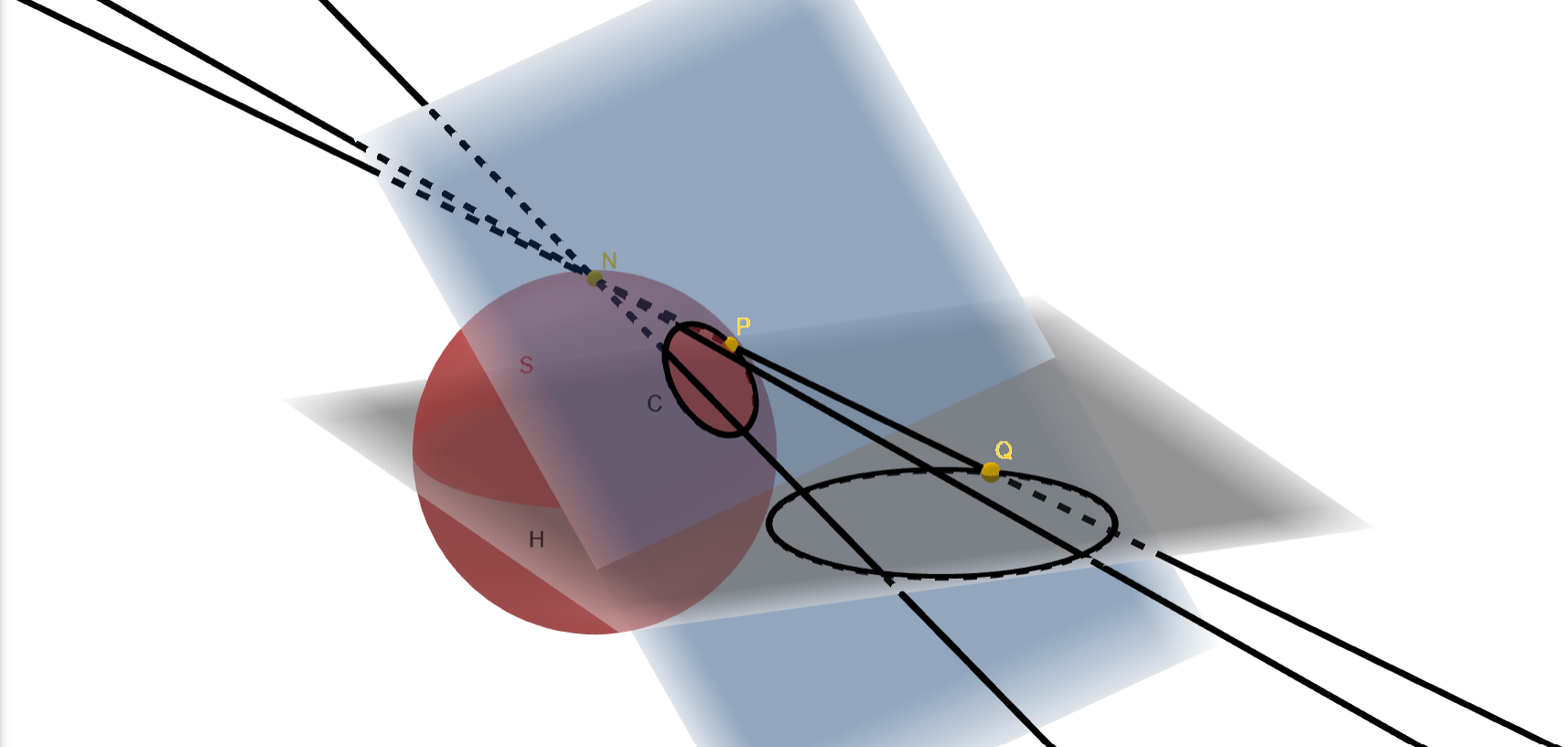
Let SS denote the unit sphere in R3.\R^{3}. We call N=(0,0,1)N=(0,0,1) its North pole and write HH the horizontal plane, which has equation z=0.z=0. Let π\pi be the stereographic projection from NN onto H:H: it sends any point PNP \neq N on SS to the intersection QQ of the line (NP)(NP) and the plane H.H.
Let CC be the intersection of SS with an affine plane in R3\R^{3} such that CC contains at least 22 points.

Prove that the image π(C)\pi(C) of the circle CC by the stereographic projection is a circle in HH if S∉CS \not\in C, and that it is a line in HH otherwise.
geogeb

I solved itMark it doneAdd to my listKeep it in your list

Hints

1

Hint 1

Open this only if you want a small nudge before looking at the solutions.

Solutions

1
Reveal solutionsAre you sure? Give it a try first.

Solution by AilDesOursFR

Discussions0 useful votes

Preuve en utilisant l’inversion.
Soit II l’inversion de pôle NN et de puissance 2R2=22R^{2}=2. La projection stéréographique est la restriction de II à la sphère de l’espace R3\mathbb{R}^3.
Cas NCN \notin C
Soit SS une sphère qui admet pour grand cercle CC. L’image par II de SS est une sphère (on pourrait d’ailleurs trouver le rayon). Mais l’image par II de CC est dans le plan z=0z=0. L’intersection donne donc un cercle.
Cas NCN \in C
L’image par II d’un cercle passant par son pôle NN est une droite dans le plan contenant le cercle. Cette droite est perpendiculaire à la droite passant par son centre et NN. L’image de CC étant dans le plan z=0z=0, c’est donc une droite de HH.

Report

For an unclear, ambiguous, or possibly incorrect statement, please use the Discussion tab on the right. Report content that needs moderator intervention, such as dangerous, clearly non-mathematical, or plagiarized content.