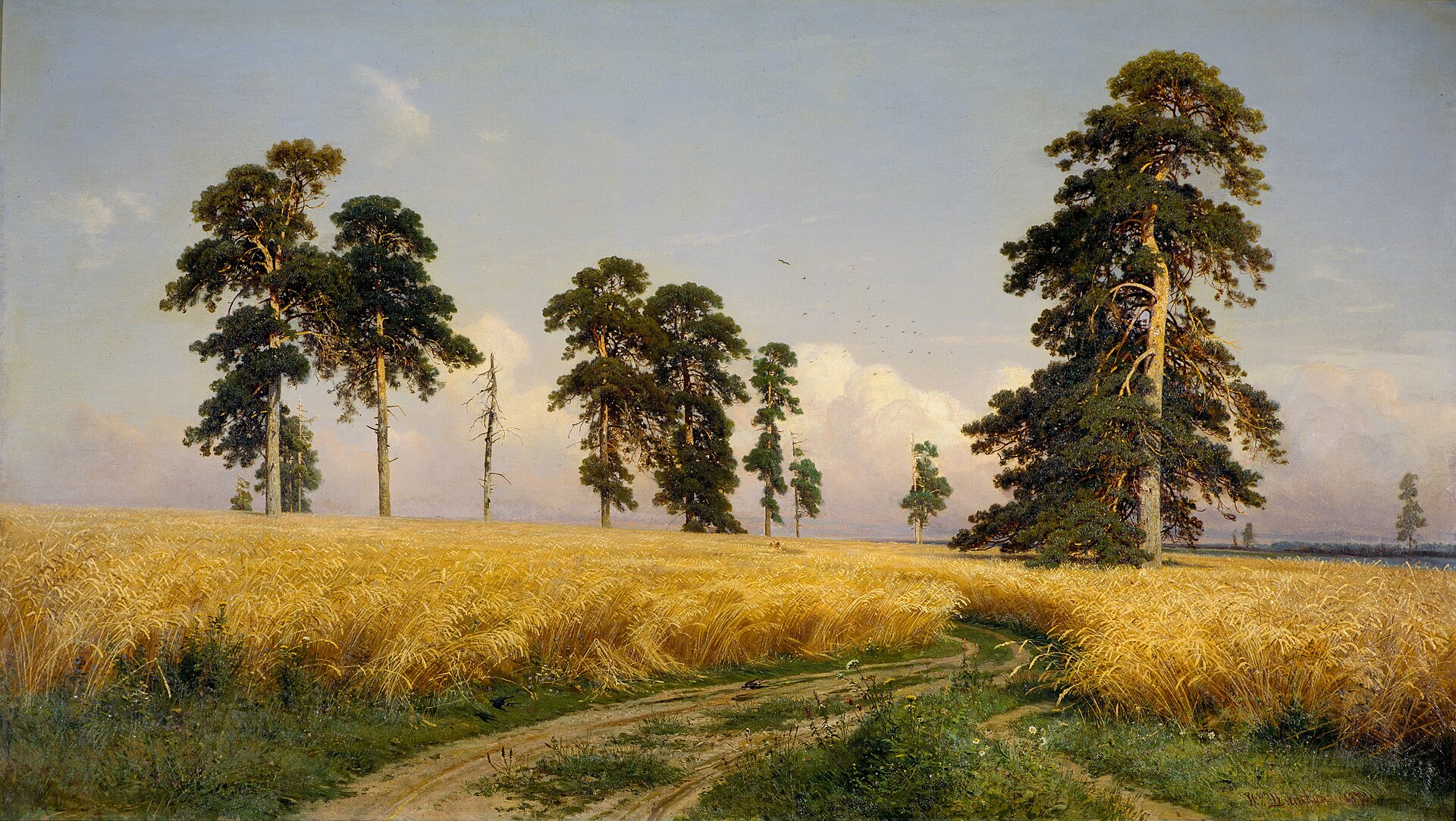
Ivan Shishkin, Rye (1878)

Discussions

Mes premières fonctions impaires

0 messages

Solution

Solution by darktoaster · FR

0)\textbf{0)} Remarque: Pour n∈Nn \in \mathbb{N}, x↦xnx\mapsto x^{n} est paire si nn est pair, x↦xnx \mapsto x^{n} est impaire si nn impair.

Exemples :
x↦x3x \mapsto x^3 est impaire car pour tout x∈Rx\in\R, (−x)3=(−1)3x3=−x3(-x)^3 = (-1)^3 x^3 = -x^3.

x↦x4x \mapsto x^4 est paire car pour tout x∈Rx\in\R, (−x)4=(−1)4x4=−x4(-x)^4 = (-1)^4 x^4 = -x^4.

1)\textbf{1)} On note ff la fonction x↦x3+xx \mapsto x^{3}+x.
Pour tout x∈Rx\in\R, f(−x)=(−x)3+(−x)=−x3−x=−(x3+x)=−f(x)f(-x) = (-x)^{3} + (-x) = -x^{3} - x = -(x^{3}+x) = -f(x).
Donc ff est impaire.

2)\textbf{2)} On note gg la fonction x↦xx4+1x\mapsto \frac{x}{\sqrt{x^4 +1}}.
Pour tout x∈Rx\in\R, g(−x)=−x(−x)4+1=−xx4+1=−xx4+1=−g(x)g(-x) = \frac{-x}{\sqrt{(-x)^{4}+1}}= \frac{-x}{\sqrt{x^{4}+1}}=-\frac{x}{\sqrt{x^{4}+1}} = -g(x).
Donc gg est impaire.

No messages yet.