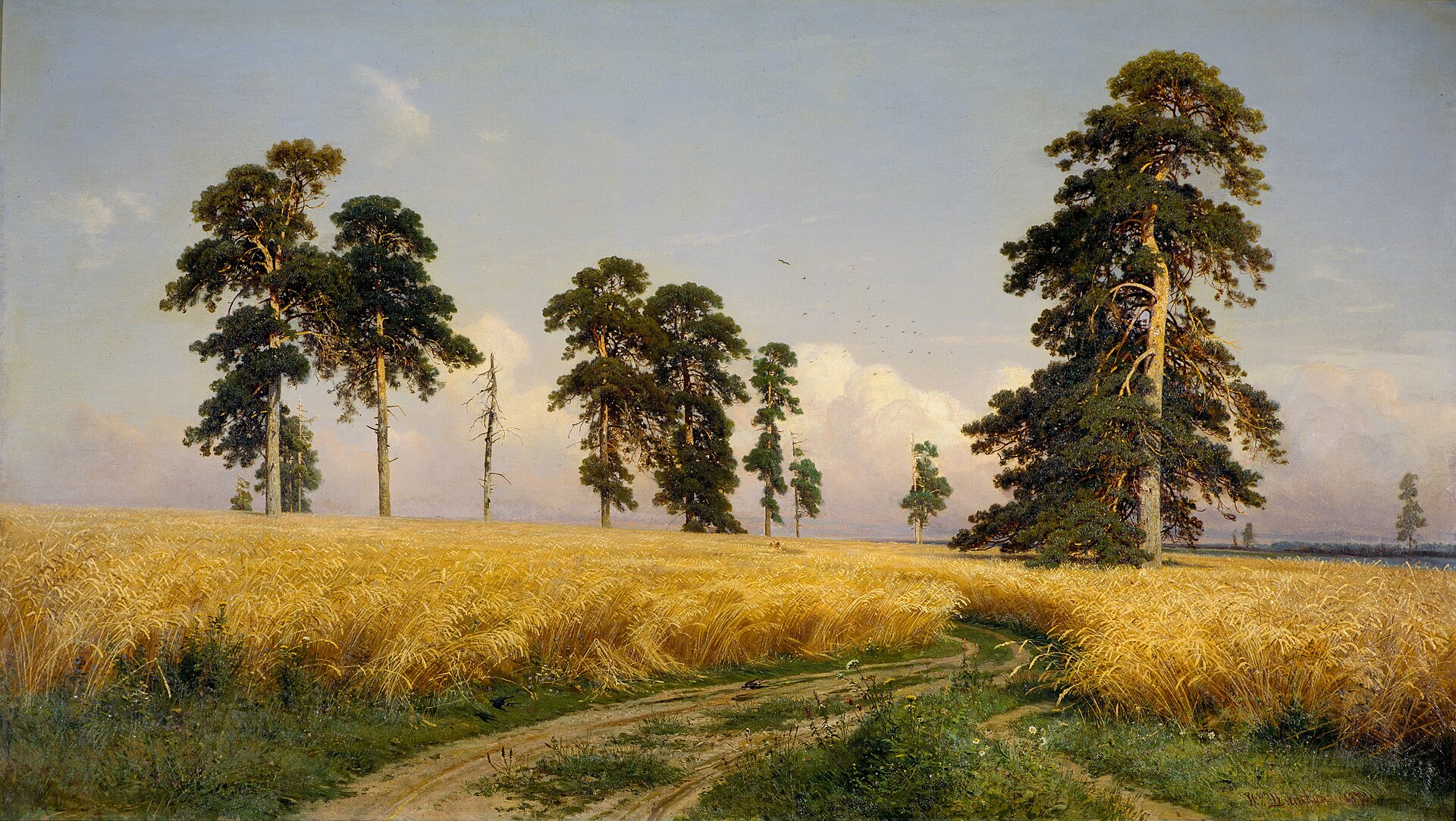
Ivan Shishkin, Rye (1878)

Problems/Sequence and seriesReviewed

Some bounded sequences that always converge

by Sequoia·
54
Difficulty scaleÉchelle de difficulté

This score reflects both the level of the required concepts and the difficulty of the solution.Ce score tient compte à la fois du niveau des notions nécessaires et de la difficulté de la résolution.

  1. 1–10First steps / middle schoolPremiers pas / collège
  2. 11–25Beginner / high schoolDébutant / lycée
  3. 26–50Intermediate / undergraduateIntermédiaire / licence
  4. 51–70Advanced / graduateAvancé / master
  5. 71–90Expert / specializedExpert / spécialisé
  6. 91–100Research levelNiveau recherche
These levels are approximate guides.Ces niveaux sont des repères approximatifs.
·
English
EnglishFrançais

Let α∈C\alpha\in\mathbb{C} be such that ∣α∣≠1\vert \alpha\vert\neq1 and uu be a complex sequence such that un+1−α un ⟶n→+∞0u_{n+1}-\alpha\,u_n\,\underset{n\to +\infty}{\longrightarrow} 0.

  1. We assume furthermore that uu is bounded. Show that uu converges.
  2. For which α\alpha can the result of 1) be generalized if uu is not bounded ?
  3. Show that the sequence (einθ)n∈N(e^{in\theta})_{n\in\N} does not converge for all θ∈R\2πZ\theta\in\mathbb{R}\backslash 2\pi\mathbb{Z}. Conclude for the case ∣α∣=1\vert\alpha\vert=1.
I solved itMark it doneAdd to my listKeep it in your list

Solutions

1
Reveal solutionsAre you sure? Give it a try first.

Solution by visitorFR

Discussions1 useful vote
  1. Posons vn=un+1−αunv_n=u_{n+1}-\alpha u_n, ainsi vn→0v_n\to 0 et un+1=αun+vnu_{n+1}=\alpha u_n+v_n.
    Cas ∣α∣<1|\alpha|<1. Par récurrence immédiate,
    un=αnu0+∑k=0n−1α n−1−kvk.u_n=\alpha^n u_0+\sum_{k=0}^{n-1}\alpha^{\,n-1-k}v_k.Soit ε>0\varepsilon>0 et NN tel que ∣vk∣≤ε|v_k|\leq\varepsilon pour k≥Nk\geq N. En scindant la somme,
    ∣∑k=0n−1α n−1−kvk∣≤∣α∣ n−N∑k=0N−1∣α∣N−1−k∣vk∣+ε1−∣α∣.\Big|\sum_{k=0}^{n-1}\alpha^{\,n-1-k}v_k\Big|\leq |\alpha|^{\,n-N}\sum_{k=0}^{N-1}|\alpha|^{N-1-k}|v_k|+\frac{\varepsilon}{1-|\alpha|}.Le premier terme tend vers 00 quand n→+∞n\to+\infty (NN étant fixé), ainsi que αnu0\alpha^nu_0. Donc lim sup⁡∣un∣≤ε1−∣α∣\limsup|u_n|\leq \dfrac{\varepsilon}{1-|\alpha|} pour tout ε>0\varepsilon>0, c’est-à-dire un→0u_n\to 0. Noter que l’hypothèse bornée n’a pas servi.

Cas ∣α∣>1|\alpha|>1. On renverse la relation : un=un+1−vnαu_n=\dfrac{u_{n+1}-v_n}{\alpha}, puis par récurrence sur pp,
un=un+pαp−∑j=0p−1vn+jα j+1.u_n=\frac{u_{n+p}}{\alpha^p}-\sum_{j=0}^{p-1}\frac{v_{n+j}}{\alpha^{\,j+1}}.Comme uu est bornée et ∣α∣>1|\alpha|>1, le terme un+p/αpu_{n+p}/\alpha^p tend vers 00 quand p→+∞p\to+\infty ; la série converge absolument, d’où
un=−∑j≥0vn+jα j+1,donc∣un∣≤sup⁡k≥n∣vk∣∣α∣−1→n→+∞0.u_n=-\sum_{j\geq 0}\frac{v_{n+j}}{\alpha^{\,j+1}},\qquad\text{donc}\qquad |u_n|\leq \frac{\sup_{k\geq n}|v_k|}{|\alpha|-1}\xrightarrow[n\to+\infty]{}0.Dans les deux cas uu converge, et sa limite est 00. C’est cohérent : si un→ℓu_n\to \ell, le passage à la limite dans un+1−αun→0u_{n+1}-\alpha u_n\to 0 donne (1−α)ℓ=0(1-\alpha)\ell=0, et α≠1\alpha\neq 1 puisque ∣α∣≠1|\alpha|\neq 1.

  1. Le résultat se généralise pour ∣α∣<1|\alpha|<1 (déjà montré).
    Si ∣α∣>1|\alpha|>1, prendre un=αnu_n=\alpha^n : alors un+1−αun=0u_{n+1}-\alpha u_n=0, mais ∣un∣=∣α∣n→+∞|u_n|=|\alpha|^n\to+\infty et uu diverge.

  2. Supposons einθ→Le^{in\theta}\to L. En passant à la limite dans ei(n+1)θ=eiθeinθe^{i(n+1)\theta}=e^{i\theta}e^{in\theta}, on obtient L=eiθLL=e^{i\theta}L. Or ∣L∣=lim⁡∣einθ∣=1|L|=\lim|e^{in\theta}|=1, donc L≠0L\neq 0 et eiθ=1e^{i\theta}=1, soit θ∈2πZ\theta\in 2\pi\mathbb{Z} : contradiction.
    Conclusion pour ∣α∣=1|\alpha|=1. Le résultat de la question 1 tombe en défaut.

Si α=eiθ\alpha=e^{i\theta} avec θ∉2πZ\theta\notin 2\pi\mathbb{Z}, la suite un=αnu_n=\alpha^n est bornée et vérifie un+1−αun=0u_{n+1}-\alpha u_n=0, mais elle diverge d’après ce qui précède.

Si α=1\alpha=1, prendre un=sin⁡(n)u_n=\sin(\sqrt n). Elle est bornée et, par l’inégalité des accroissements,
∣un+1−un∣≤sup⁡x≥n∣cos⁡(ln⁡x)∣x≤1n⟶0.\left|u_{n+1}-u_n\right| \leq \sup _{x \geq n} \frac{|\cos (\ln x)|}{x} \leq \frac{1}{n} \longrightarrow 0 .Pour kk entier, posons
nk=⌈eπ/2+2kπ⌉,mk=⌈e−π/2+2kπ⌉.n_k=\left\lceil e^{\pi / 2+2 k \pi}\right\rceil, \quad m_k=\left\lceil e^{-\pi / 2+2 k \pi}\right\rceil .Alors ln⁡nk=π2+2kπ+δk\ln n_k=\frac{\pi}{2}+2 k \pi+\delta_k avec 0≤δk≤ln⁡(1+e−π/2−2kπ)→00 \leq \delta_k \leq \ln \left(1+e^{-\pi / 2-2 k \pi}\right) \rightarrow 0, donc unk=u_{n_k}= sin⁡(ln⁡nk)→1\sin \left(\ln n_k\right) \rightarrow 1. De même umk→−1u_{m_k} \rightarrow-1. Deux sous-suites de limites distinctes : uu diverge.

Bilan : la propriété « uu bornée et un+1−αun→0u_{n+1}-\alpha u_n\to 0 ⇒\Rightarrow uu converge » vaut si et seulement si ∣α∣≠1|\alpha|\neq 1, et sans l’hypothèse bornée si et seulement si ∣α∣<1|\alpha|<1.

Report

For an unclear, ambiguous, or possibly incorrect statement, please use the Discussion tab on the right. Report content that needs moderator intervention, such as dangerous, clearly non-mathematical, or plagiarized content.