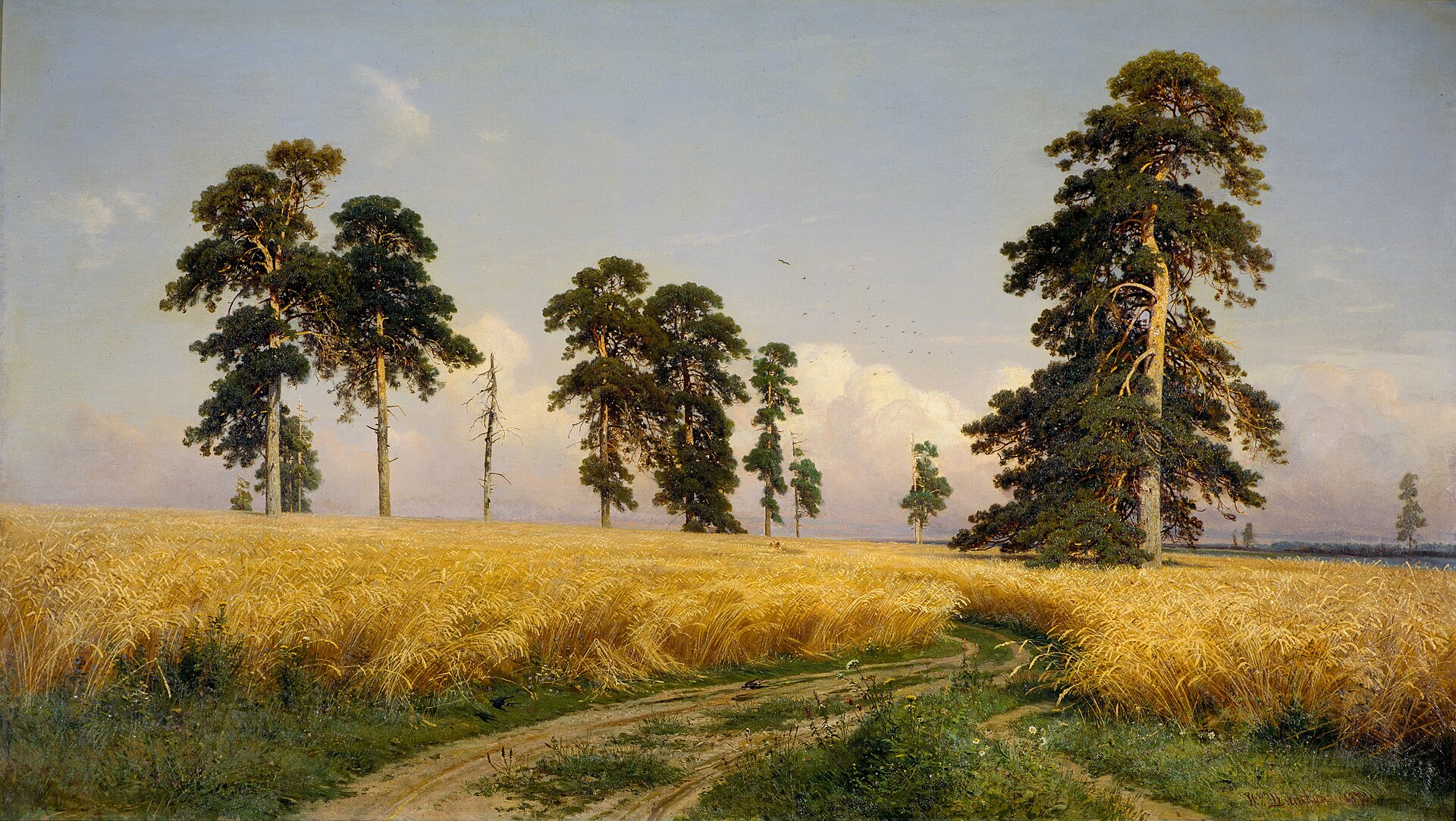
Ivan Shishkin, Rye (1878)

Problems/Riemann integrationExerciseUnreviewed

"Quick" integrations by part (level 33)

by Sequoia·
22
Difficulty scaleÉchelle de difficulté

This score reflects both the level of the required concepts and the difficulty of the solution.Ce score tient compte à la fois du niveau des notions nécessaires et de la difficulté de la résolution.

  1. 1–10First steps / middle schoolPremiers pas / collège
  2. 11–25Beginner / high schoolDébutant / lycée
  3. 26–50Intermediate / undergraduateIntermédiaire / licence
  4. 51–70Advanced / graduateAvancé / master
  5. 71–90Expert / specializedExpert / spécialisé
  6. 91–100Research levelNiveau recherche
These levels are approximate guides.Ces niveaux sont des repères approximatifs.
·
English
EnglishFrançais
Unreviewed. This problem has not been reviewed by trusted users yet.

Compute the following integrals using one (or several !) integration by part.

  1. ∫01exsin⁡(x) dx\displaystyle\int_0^{1}e^x\sin(x)\,\mathrm{d}x by integrating only exp⁡\exp.

  2. ∫01arcsin⁡(u) dt\displaystyle\int_0^{1}\arcsin(u)\,\mathrm{d}t by differentiating arcsin⁡\arcsin.

  3. ∫1eln⁡(t)2 dt\displaystyle\int_1^{e}\ln(t)^2\,\mathrm{d}t starting by differentiating ln⁡2\ln^2.

I solved itMark it doneAdd to my listKeep it in your list

Solutions

1
Reveal solutionsAre you sure? Give it a try first.

Solution by visitorFR

Discussions2 useful votes
  1. L’exponentielle étant invariante par intégration, la consigne impose de l’intégrer à chaque fois. Deux intégrations par parties ramènent alors l’intégrale à elle-même.
    Avec f(x)=sin⁡xf(x)=\sin x et g′(x)=exg'(x)=e^{x} :
    I=∫01exsin⁡x dx=[exsin⁡x]01−∫01excos⁡x dx=esin⁡1−J.I=\int_0^1 e^{x}\sin x\,\mathrm{d}x=\Bigl[e^{x}\sin x\Bigr]_0^1-\int_0^1 e^{x}\cos x\,\mathrm{d}x=e\sin 1-J .Avec f(x)=cos⁡xf(x)=\cos x et g′(x)=exg'(x)=e^{x}, en notant que cos⁡′=−sin⁡\cos'=-\sin :
    J=∫01excos⁡x dx=[excos⁡x]01+∫01exsin⁡x dx=ecos⁡1−1+I.J=\int_0^1 e^{x}\cos x\,\mathrm{d}x=\Bigl[e^{x}\cos x\Bigr]_0^1+\int_0^1 e^{x}\sin x\,\mathrm{d}x=e\cos 1-1+I .En reportant, I=esin⁡1−ecos⁡1+1−II=e\sin 1-e\cos 1+1-I, d’où 2I=e(sin⁡1−cos⁡1)+12I=e(\sin 1-\cos 1)+1 et
     ∫01exsin⁡x dx=e(sin⁡1−cos⁡1)+12.\boxed{\ \int_0^1 e^{x}\sin x\,\mathrm{d}x=\frac{e(\sin 1-\cos 1)+1}{2}. }

  2. Il n’y a qu’un facteur : on dérive arcsin⁡\arcsin et l’on intègre la fonction constante 11. Avec f(u)=arcsin⁡uf(u)=\arcsin u, g′(u)=1g'(u)=1, g(u)=ug(u)=u :
    ∫01arcsin⁡u du=[uarcsin⁡u]01−∫01u1−u2 du=π2−K.\int_0^1\arcsin u\,\mathrm{d}u=\Bigl[u\arcsin u\Bigr]_0^1-\int_0^1\frac{u}{\sqrt{1-u^{2}}}\,\mathrm{d}u=\frac{\pi}{2}-K .L’intégrande restant s’intègre directement, en reconnaissant −ddu1−u2-\frac{\mathrm{d}}{\mathrm{d}u}\sqrt{1-u^{2}} :
    K=[−1−u2]01=0−(−1)=1.K=\Bigl[-\sqrt{1-u^{2}}\Bigr]_0^1=0-(-1)=1 .D’où
     ∫01arcsin⁡u du=π2−1.\boxed{\ \int_0^1\arcsin u\,\mathrm{d}u=\frac{\pi}{2}-1 .}

  3. Même situation : on dérive ln⁡2\ln^{2} et l’on intègre 11. Avec f(t)=ln⁡2tf(t)=\ln^{2}t, f′(t)=2ln⁡ttf'(t)=\frac{2\ln t}{t} et g(t)=tg(t)=t :
    ∫1eln⁡2t dt=[tln⁡2t]1e−∫1e2ln⁡t dt=e−2∫1eln⁡t dt.\int_1^e\ln^{2}t\,\mathrm{d}t=\Bigl[t\ln^{2}t\Bigr]_1^e-\int_1^e 2\ln t\,\mathrm{d}t=e-2\int_1^e\ln t\,\mathrm{d}t .La seconde intégrale se traite de la même façon, avec f(t)=ln⁡tf(t)=\ln t et g(t)=tg(t)=t :
    ∫1eln⁡t dt=[tln⁡t]1e−∫1e1 dt=e−(e−1)=1.\int_1^e\ln t\,\mathrm{d}t=\Bigl[t\ln t\Bigr]_1^e-\int_1^e 1\,\mathrm{d}t=e-(e-1)=1 .Finalement
     ∫1eln⁡2t dt=e−2.\boxed{\ \int_1^e\ln^{2}t\,\mathrm{d}t=e-2. }

Report

For an unclear, ambiguous, or possibly incorrect statement, please use the Discussion tab on the right. Report content that needs moderator intervention, such as dangerous, clearly non-mathematical, or plagiarized content.