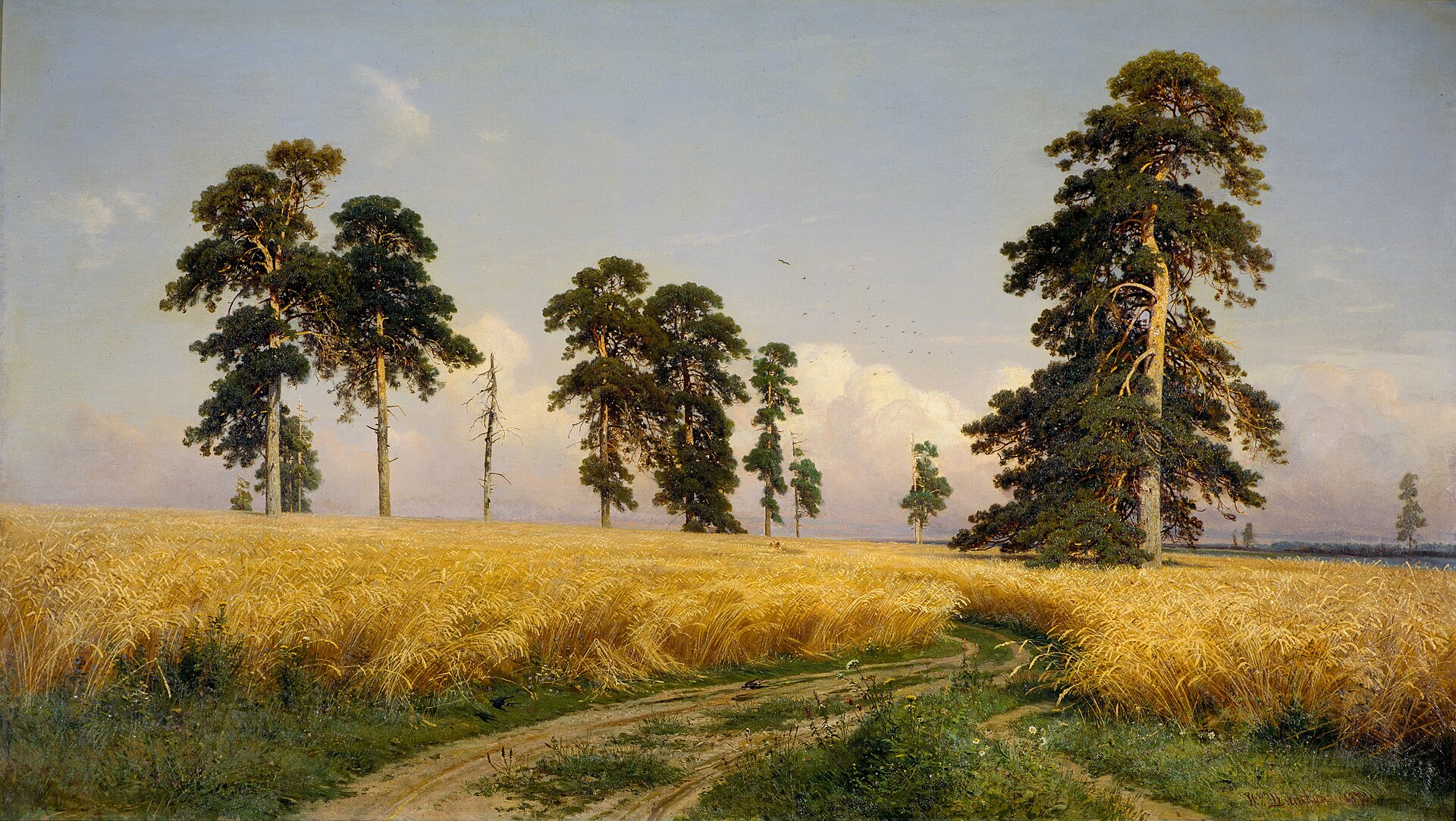

Ivan Shishkin, Rye (1878)

Problems/GeometryUnreviewed

What is the blind spot from a monitoring room ?

by Sequoia·
44
Difficulty scaleÉchelle de difficulté

This score reflects both the level of the required concepts and the difficulty of the solution.Ce score tient compte à la fois du niveau des notions nécessaires et de la difficulté de la résolution.

  1. 1–10First steps / middle schoolPremiers pas / collège
  2. 11–25Beginner / high schoolDébutant / lycée
  3. 26–50Intermediate / undergraduateIntermédiaire / licence
  4. 51–70Advanced / graduateAvancé / master
  5. 71–90Expert / specializedExpert / spécialisé
  6. 91–100Research levelNiveau recherche
These levels are approximate guides.Ces niveaux sont des repères approximatifs.
·
English
EnglishFrançais
Unreviewed. This problem has not been reviewed by trusted users yet.

Three surveillance cameras AA, BB and CC are installed to monitor a triangular restricted area. What is the point MM inside ABCABC that gets the minimal exposure from these three cameras ? Here we define the exposure as the inverse of the product of distances from the cameras.

I solved itMark it doneAdd to my listKeep it in your list

Solutions

1
Reveal solutionsAre you sure? Give it a try first.

Solution by ferntreeFR

Discussions0 useful votes

On identifie les points AA, BB et CC à leurs affixes complexes aa, bb et cc. Le point MM, d’affixe zz, minimise l’exposition définie par (∣z−a∣∣z−b∣∣z−c∣)−1(|z - a| |z - b| |z - c|)^{-1}. Autrement dit, MM maximise ∣z−a∣∣z−b∣∣z−c∣|z - a| |z - b| |z - c| et puisque la fonction x↦ln⁡(x2)x \mapsto \ln(x^{2}) est croissante sur R+\mathbb{R}_{+}, MM maximise aussi ln⁡∣z−a∣2+ln⁡∣z−b∣2+ln⁡∣z−c∣2\ln |z - a|^{2} + \ln |z - b|^{2} + \ln |z - c|^{2}. En mettant la dérivée de cette dernière quantité à zéro, on obtient la condition
z−a∣z−a∣2+z−b∣z−b∣2+z−c∣z−c∣2=0.\frac{z - a}{|z - a|^{2}}+\frac{z - b}{|z - b|^{2}}+\frac{z - c}{|z - c|^{2}} = 0.En utilisant le fait que ∣z∣2=zˉz|z|^{2} = \bar{z} z, cette condition se réécrit
1z−a+1z−b+1z−c=0,\frac{1}{z - a}+\frac{1}{z-b}+\frac{1}{z-c} = 0,où on a pris la partie conjuguée. On reconnaît la dérivée logarithmique du polynôme P(z)=(z−a)(z−b)(z−c)P(z) = (z - a) (z - b) (z - c). La condition se réécrit P′(z)/P(z)=0P'(z) / P(z) = 0, donc zz est une racine de P′P'. Dans le cas général, il y a donc deux points qui minimisent l’exposition. D’après le théorème de Marden, ces deux points sont les foyers de l’ellipse de Steiner inscrite au triangle ABCABC. Le calcul de P′P' donne 3z2−2(a+b+c)z+(bc+ac+ab)3 z^{2} - 2 (a + b + c) z + (b c + a c + a b), donc zz est de la forme
z=a+b+c±(a2+b2+c2)−(bc+ac+ab)3.z = \frac{a + b + c \pm \sqrt{(a^{2} + b^{2} + c^{2}) - (b c + a c + a b)}}{3}.

Report

For an unclear, ambiguous, or possibly incorrect statement, please use the Discussion tab on the right. Report content that needs moderator intervention, such as dangerous, clearly non-mathematical, or plagiarized content.