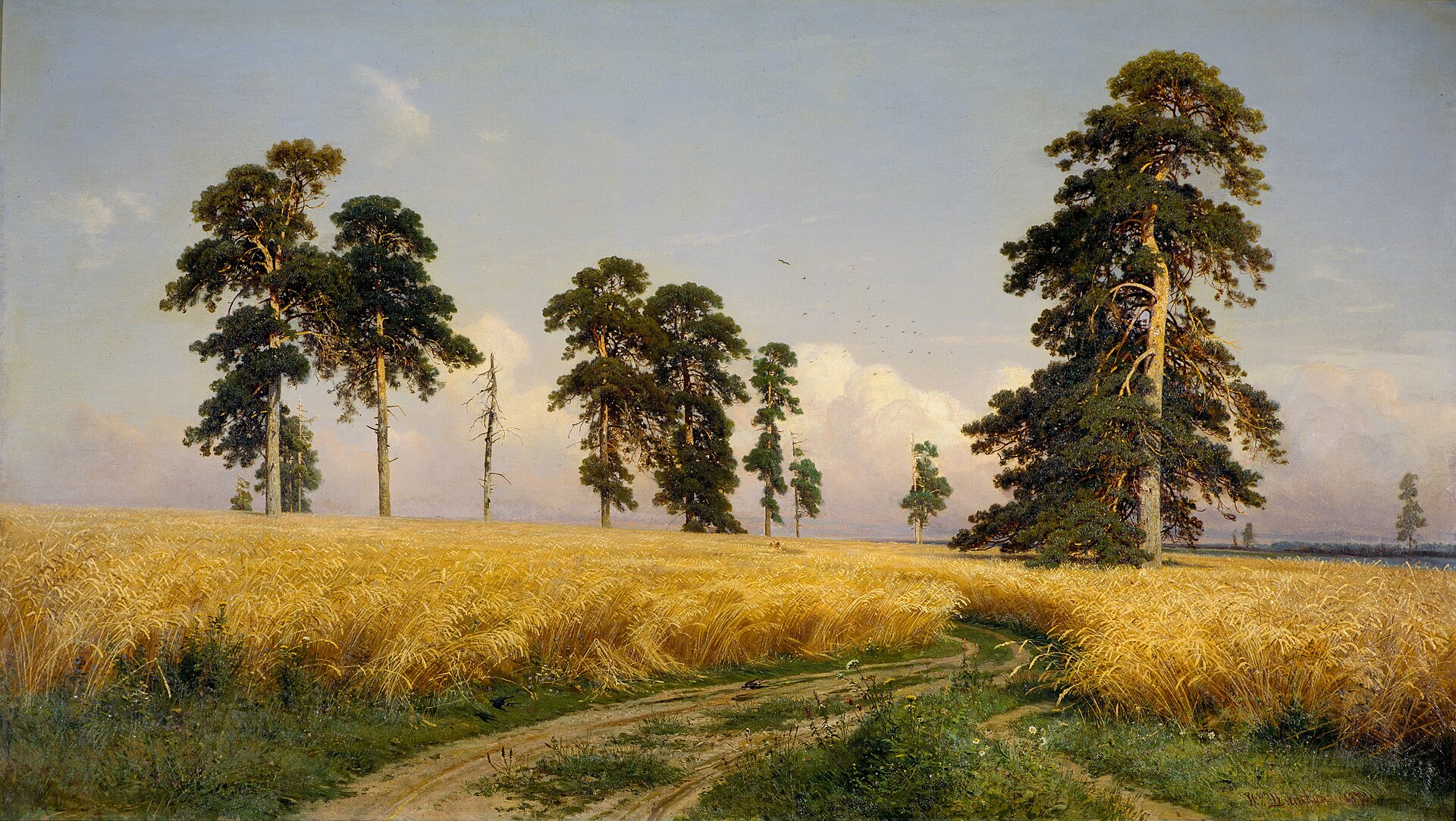
Ivan Shishkin, Rye (1878)

Discussions

Tribu des parties

0 messages

Solution

Solution by darktoaster · FR

P(X)\mathcal{P}(X) est une tribu sur XX.
1)\textbf{1)} P(X)\mathcal{P}(X) contient XX et ∅\emptyset. En effet : X⊂XX \subset X et ∅⊂X\emptyset \subset X
2)\textbf{2)} P(X)\mathcal{P}(X) est stable par complémentaire. Soit A∈P(X)A \in \mathcal{P}(X). A⊂XA\subset X. XX est l’ensemble ambiant, AcA^{c} - le complémentaire de AA - est aussi dans XX.
3)\textbf{3)} P(X)\mathcal{P}(X) est stable par union dénomabrable : Soit (An)n∈N(A_{n})_{n\in \mathbb N} une suite d’éléments de P(X)\mathcal{P}(X). ∀n∈N,An⊂X\forall n \in \mathbb{N}, A_{n} \subset X. ⋃n∈NAn⊂X\bigcup\limits_{n\in\mathbb N} A_{n} \subset X. En effet, soit x∈⋃n∈NAnx \in \bigcup\limits_{n\in\mathbb N} A_{n}, il existe un n0∈Nn_{0} \in \mathbb{N} tel que x∈An0x \in A_{n_{0}} , donc x∈Xx \in X.

No messages yet.