Ivan Shishkin, Rye (1878)

Discussions

Un pavé dans la mare

0 messages

Solution

Solution by FiniteField · FR

Solution en vidéo : https://youtu.be/Vh6Yj0xmAYE

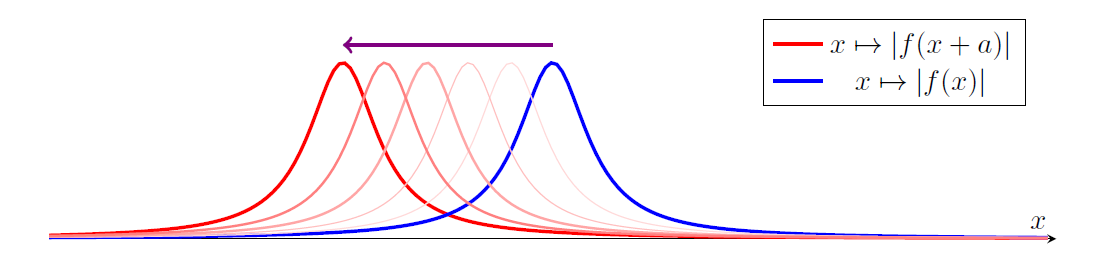
On devine la limite en faisant un dessin :
Capture d'écran 2026 10 09 123254
En effet, on a le sentiment que pour aa assez grand f(x)f(x) ou f(x+a)f(x+a) est assez petit quel que soit x.x. En soit cette idée est fausse car une fonction même intégrable n’a aucune raison d’être ne serait-ce que bornée (prendre une fonction affine par morceaux qui fait des pics de plus en plus haut et fin en revenant toujours à 00 entre deux pics). Cependant, en intégrant cette idée va se révéler correcte et on va montrer que la limite est
2∫−∞+∞∣f(x)∣ dx.\displaystyle 2\int_{-\infty}^{+\infty}\mid f(x)\mid \,\mathrm{d}x.

On remarque tout d’abord que, grâce à l’inégalité triangulaire, ∀x,a∈R,∣f(x+a)−f(x)∣⩽∣f(x+a)∣+∣f(x)∣.\forall x,a\in\mathbb{R}, \left|f(x+a)-f(x)\right|\leqslant\left|f(x+a)\right|+\left|f(x)\right|. Par ailleurs, x↦f(x+a)x\mapsto f(x+a) est intégrable et de même intégrale que ff grâce au changement de variable y=x+a.y=x+a. Ceci prouve que l’intégrale qui nous intéresse existe et que
∫−∞+∞∣f(x+a)−f(x)∣ dx⩽∫−∞+∞∣f(x+a)∣ dx+∫−∞+∞∣f(x)∣ dx=2∫−∞+∞∣f(x)∣ dx.\int_{-\infty}^{+\infty}\left|f(x+a)-f(x)\right|\,\mathrm{d}x \leqslant \int_{-\infty}^{+\infty}\left|f(x+a)\right|\,\mathrm{d}x +\int_{-\infty}^{+\infty}\left|f(x)\right|\,\mathrm{d}x =2\int_{-\infty}^{+\infty}\left|f(x)\right|\,\mathrm{d}x.L’idée pour poursuivre est de comprendre pour quelles fonctions gg intégrables on a l’égalité (à partir de aa assez grand au moins) ∫−∞+∞∣g(x+a)−g(x)∣ dx=2∫−∞+∞∣g(x)∣ dx.\displaystyle\int_{-\infty}^{+\infty}\left|g(x+a)-g(x)\right|\,\mathrm{d}x=2\int_{-\infty}^{+\infty}\left|g(x)\right|\,\mathrm{d}x. On voit sur un dessin que c’est le cas lorsque gg est à support compact, ou dit plus simplement, lorsque g(x)g(x) est nulle pour ∣x∣\left|x\right| assez grand. Prouvons-le. Soit α>0\alpha>0 et gg continue par morceaux et nulle sur R∖[−α,α]\mathbb{R}\setminus [-\alpha,\alpha] alors gg est automatiquement intégrable sur R\mathbb{R} par construction de l’intégrale sur un segment. On a alors ∀a>2α,∀x∈R,∣x+a−x∣=a>2α\forall a>2\alpha, \forall x\in\mathbb{R}, \left|x+a-x\right|=a>2\alpha donc xx et x+ax+a ne peuvent être simultanément dans [−α,α][-\alpha,\alpha] donc g(x)=0g(x)=0 ou g(x+a)=0.g(x+a)=0. On en déduit que
∫−∞+∞∣g(x+a)−g(x)∣ dx=⏟Chasles∫−αα∣g(x+a)⏟=0−g(x)∣ dx+∫R∖[−α,α]∣g(x+a)−g(x)⏟=0∣ dx=2∫−∞+∞∣g(x)∣ dx.\int_{-\infty}^{+\infty}\left|g(x+a)-g(x)\right|\,\mathrm{d}x \underbrace{=}_{\text{\footnotesize Chasles}} \int_{-\alpha}^{\alpha}\mid \underbrace{g(x+a)}_{=0}-g(x)\mid\,\mathrm{d}x +\int_{\mathbb{R}\setminus[-\alpha,\alpha]}\mid g(x+a)-\underbrace{g(x)}_{=0}\mid\,\mathrm{d}x =2\int_{-\infty}^{+\infty}\left|g(x)\right|\,\mathrm{d}x.On revient à notre fonction ff. Puisque ff est intégrable lim⁡α→∞∫−αα∣f(x)∣ dx=∫−∞+∞∣f(x)∣ dx.\lim\limits_{\alpha\to\infty}\displaystyle\int_{-\alpha}^\alpha \left|f(x)\right|\,\mathrm{d}x=\int_{-\infty}^{+\infty}\left|f(x)\right|\,\mathrm{d}x. Soit ε>0\varepsilon>0 tel que que ∣∫−∞+∞∣f(x)∣ dx−∫−α+α∣f(x)∣ dx∣<ε.\displaystyle\left|\int_{-\infty}^{+\infty}\left|f(x)\right|\,\mathrm{d}x-\int_{-\alpha}^{+\alpha}\left|f(x)\right|\,\mathrm{d}x\right|<\varepsilon. On pose alors gα ⁣:x∈R↦1[−α,α](x)f(x)g_\alpha\colon x\in\mathbb{R}\mapsto \mathbf{1}_{[-\alpha,\alpha]}(x)f(x) avec 1[−α,α](x)=1\mathbf{1}_{[-\alpha,\alpha]}(x)=1 si x∈[−α,α]x\in[-\alpha,\alpha] et 00 sinon. La fonction gαg_\alpha satisfait bien les critères précédemment énoncés et on a évidemment ∀x∈R,∣f(x)∣⩾∣gα(x)∣\forall x\in\mathbb{R},\left|f(x)\right|\geqslant \left|g_\alpha(x)\right| si bien que ∀x∈R,∣gα(x+a)−gα(x)∣≤∣f(x+a)∣+∣f(x)∣.\forall x\in\mathbb{R},\left|g_\alpha(x+a)-g_\alpha(x)\right|\leq \left|f(x+a)\right|+\left|f(x)\right|. Or la fonction φ ⁣:x∈R↦∣f(x+a)∣+∣f(x)∣\varphi\colon x\in\mathbb{R}\mapsto \left|f(x+a)\right|+\left|f(x)\right| est intégrable donc on peut passer à la limite lorsque α→+∞\alpha\to+\infty. Puisque (gα)α(g_\alpha)_\alpha converge simplement vers ff on a, par convergence dominée,
lim⁡α→+∞∫R∣gα(x+a)−gα(x)∣ dx=∫R∣f(x+a)−f(x)∣ dx\displaystyle\lim\limits_{\alpha\to+\infty}\int_\mathbb{R} \left|g_\alpha(x+a)-g_\alpha(x)\right|\,\mathrm{d}x=\displaystyle\int_\mathbb{R} \left|f(x+a)-f(x)\right|\,\mathrm{d}x. On peut alors, quitte à choisir α\alpha plus grand, supposer que ces deux intégrales sont distantes de moins de ε.\varepsilon. On a donc pour a>2α,a>2\alpha,
∫−∞+∞∣gα(x+a)−gα(x)∣ dx−ε=2∫−∞+∞∣gα(x)∣ dx−ε⩽∫−∞+∞∣f(x+a)−f(x)∣ dx\int_{-\infty}^{+\infty} \left|g_\alpha(x+a)-g_\alpha(x)\right|\,\mathrm{d}x-\varepsilon =2\int_{-\infty}^{+\infty} \left|g_\alpha(x)\right|\,\mathrm{d}x-\varepsilon \leqslant\int_{-\infty}^{+\infty} \left|f(x+a)-f(x)\right|\,\mathrm{d}xdonc ∀ε>0,\forall \varepsilon>0, pour aa assez grand,
2∫−∞+∞∣f(x)∣ dx−3ε⩽∫−∞+∞∣f(x+a)−f(x)∣ dx⩽2∫−∞+∞∣f(x)∣ dx2\int_{-\infty}^{+\infty} \left|f(x)\right|\,\mathrm{d}x-3\varepsilon \leqslant\int_{-\infty}^{+\infty} \left|f(x+a)-f(x)\right|\,\mathrm{d}x \leqslant 2\int_{-\infty}^{+\infty} \left|f(x)\right|\,\mathrm{d}xce qui prouve que
lim⁡a→+∞∫−∞+∞∣f(x+a)−f(x)∣ dx=2∫−∞+∞∣f(x)∣ dx.\lim_{a\to+\infty}\int_{-\infty}^{+\infty} \left|f(x+a)-f(x)\right|\,\mathrm{d}x =2\int_{-\infty}^{+\infty}\left|f(x)\right|\,\mathrm{d}x.

Solution edit history

The latest 50 recorded edits.

  1. · FiniteField

    Edit without a summary.

No messages yet.