Ivan Shishkin, Rye (1878)

Problems/Riemann integrationUnreviewed

Un pavé dans la mare

by FiniteField·
45
Difficulty scaleÉchelle de difficulté

This score reflects both the level of the required concepts and the difficulty of the solution.Ce score tient compte à la fois du niveau des notions nécessaires et de la difficulté de la résolution.

  1. 1–10First steps / middle schoolPremiers pas / collège
  2. 11–25Beginner / high schoolDébutant / lycée
  3. 26–50Intermediate / undergraduateIntermédiaire / licence
  4. 51–70Advanced / graduateAvancé / master
  5. 71–90Expert / specializedExpert / spécialisé
  6. 91–100Research levelNiveau recherche
These levels are approximate guides.Ces niveaux sont des repères approximatifs.
·
Français

Showing the Français version because no English translation exists yet. Add that translation.

Unreviewed. This problem has not been reviewed by trusted users yet.

Soit f∈C0(R,C)f\in\mathcal{C}^0(\mathbb{R},\mathbb{C}) intégrable. Déterminer la limite lorsque aa tend vers +∞+\infty de
∫−∞+∞∣f(x+a)−f(x)∣ dx.\int_{-\infty}^{+\infty}\mid f(x+a)-f(x)\mid\,\mathrm{d}x.

I solved itMark it doneAdd to my listKeep it in your list

References

  1. Oral Polytechnique filière PSI 2020 (RMS 131-2 173)
Details

Download: BibTeXJSON

Hints

2

Hint 1

Open this only if you want a small nudge before looking at the solutions.

Solutions

1
Reveal solutionsAre you sure? Give it a try first.

Solution by FiniteField

Discussions0 useful votes

Solution en vidéo : https://youtu.be/Vh6Yj0xmAYE

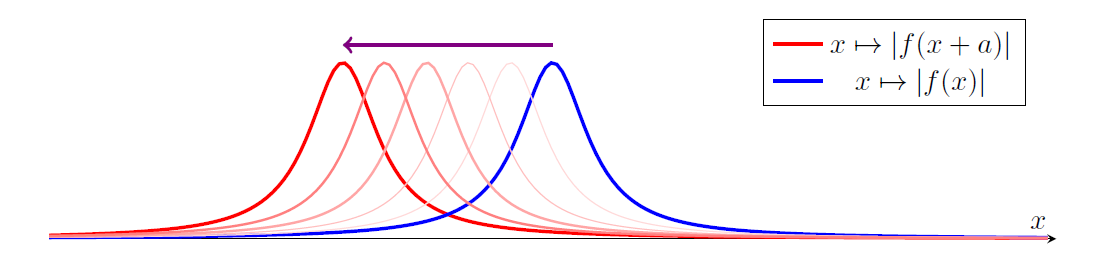
On devine la limite en faisant un dessin :
Capture d'écran 2026 10 09 123254
En effet, on a le sentiment que pour aa assez grand f(x)f(x) ou f(x+a)f(x+a) est assez petit quel que soit x.x. En soit cette idée est fausse car une fonction même intégrable n’a aucune raison d’être ne serait-ce que bornée (prendre une fonction affine par morceaux qui fait des pics de plus en plus haut et fin en revenant toujours à 00 entre deux pics). Cependant, en intégrant cette idée va se révéler correcte et on va montrer que la limite est
2∫−∞+∞∣f(x)∣ dx.\displaystyle 2\int_{-\infty}^{+\infty}\mid f(x)\mid \,\mathrm{d}x.

On remarque tout d’abord que, grâce à l’inégalité triangulaire, ∀x,a∈R,∣f(x+a)−f(x)∣⩽∣f(x+a)∣+∣f(x)∣.\forall x,a\in\mathbb{R}, \left|f(x+a)-f(x)\right|\leqslant\left|f(x+a)\right|+\left|f(x)\right|. Par ailleurs, x↦f(x+a)x\mapsto f(x+a) est intégrable et de même intégrale que ff grâce au changement de variable y=x+a.y=x+a. Ceci prouve que l’intégrale qui nous intéresse existe et que
∫−∞+∞∣f(x+a)−f(x)∣ dx⩽∫−∞+∞∣f(x+a)∣ dx+∫−∞+∞∣f(x)∣ dx=2∫−∞+∞∣f(x)∣ dx.\int_{-\infty}^{+\infty}\left|f(x+a)-f(x)\right|\,\mathrm{d}x \leqslant \int_{-\infty}^{+\infty}\left|f(x+a)\right|\,\mathrm{d}x +\int_{-\infty}^{+\infty}\left|f(x)\right|\,\mathrm{d}x =2\int_{-\infty}^{+\infty}\left|f(x)\right|\,\mathrm{d}x.L’idée pour poursuivre est de comprendre pour quelles fonctions gg intégrables on a l’égalité (à partir de aa assez grand au moins) ∫−∞+∞∣g(x+a)−g(x)∣ dx=2∫−∞+∞∣g(x)∣ dx.\displaystyle\int_{-\infty}^{+\infty}\left|g(x+a)-g(x)\right|\,\mathrm{d}x=2\int_{-\infty}^{+\infty}\left|g(x)\right|\,\mathrm{d}x. On voit sur un dessin que c’est le cas lorsque gg est à support compact, ou dit plus simplement, lorsque g(x)g(x) est nulle pour ∣x∣\left|x\right| assez grand. Prouvons-le. Soit α>0\alpha>0 et gg continue par morceaux et nulle sur R∖[−α,α]\mathbb{R}\setminus [-\alpha,\alpha] alors gg est automatiquement intégrable sur R\mathbb{R} par construction de l’intégrale sur un segment. On a alors ∀a>2α,∀x∈R,∣x+a−x∣=a>2α\forall a>2\alpha, \forall x\in\mathbb{R}, \left|x+a-x\right|=a>2\alpha donc xx et x+ax+a ne peuvent être simultanément dans [−α,α][-\alpha,\alpha] donc g(x)=0g(x)=0 ou g(x+a)=0.g(x+a)=0. On en déduit que
∫−∞+∞∣g(x+a)−g(x)∣ dx=⏟Chasles∫−αα∣g(x+a)⏟=0−g(x)∣ dx+∫R∖[−α,α]∣g(x+a)−g(x)⏟=0∣ dx=2∫−∞+∞∣g(x)∣ dx.\int_{-\infty}^{+\infty}\left|g(x+a)-g(x)\right|\,\mathrm{d}x \underbrace{=}_{\text{\footnotesize Chasles}} \int_{-\alpha}^{\alpha}\mid \underbrace{g(x+a)}_{=0}-g(x)\mid\,\mathrm{d}x +\int_{\mathbb{R}\setminus[-\alpha,\alpha]}\mid g(x+a)-\underbrace{g(x)}_{=0}\mid\,\mathrm{d}x =2\int_{-\infty}^{+\infty}\left|g(x)\right|\,\mathrm{d}x.On revient à notre fonction ff. Puisque ff est intégrable lim⁡α→∞∫−αα∣f(x)∣ dx=∫−∞+∞∣f(x)∣ dx.\lim\limits_{\alpha\to\infty}\displaystyle\int_{-\alpha}^\alpha \left|f(x)\right|\,\mathrm{d}x=\int_{-\infty}^{+\infty}\left|f(x)\right|\,\mathrm{d}x. Soit ε>0\varepsilon>0 tel que que ∣∫−∞+∞∣f(x)∣ dx−∫−α+α∣f(x)∣ dx∣<ε.\displaystyle\left|\int_{-\infty}^{+\infty}\left|f(x)\right|\,\mathrm{d}x-\int_{-\alpha}^{+\alpha}\left|f(x)\right|\,\mathrm{d}x\right|<\varepsilon. On pose alors gα ⁣:x∈R↦1[−α,α](x)f(x)g_\alpha\colon x\in\mathbb{R}\mapsto \mathbf{1}_{[-\alpha,\alpha]}(x)f(x) avec 1[−α,α](x)=1\mathbf{1}_{[-\alpha,\alpha]}(x)=1 si x∈[−α,α]x\in[-\alpha,\alpha] et 00 sinon. La fonction gαg_\alpha satisfait bien les critères précédemment énoncés et on a évidemment ∀x∈R,∣f(x)∣⩾∣gα(x)∣\forall x\in\mathbb{R},\left|f(x)\right|\geqslant \left|g_\alpha(x)\right| si bien que ∀x∈R,∣gα(x+a)−gα(x)∣≤∣f(x+a)∣+∣f(x)∣.\forall x\in\mathbb{R},\left|g_\alpha(x+a)-g_\alpha(x)\right|\leq \left|f(x+a)\right|+\left|f(x)\right|. Or la fonction φ ⁣:x∈R↦∣f(x+a)∣+∣f(x)∣\varphi\colon x\in\mathbb{R}\mapsto \left|f(x+a)\right|+\left|f(x)\right| est intégrable donc on peut passer à la limite lorsque α→+∞\alpha\to+\infty. Puisque (gα)α(g_\alpha)_\alpha converge simplement vers ff on a, par convergence dominée,
lim⁡α→+∞∫R∣gα(x+a)−gα(x)∣ dx=∫R∣f(x+a)−f(x)∣ dx\displaystyle\lim\limits_{\alpha\to+\infty}\int_\mathbb{R} \left|g_\alpha(x+a)-g_\alpha(x)\right|\,\mathrm{d}x=\displaystyle\int_\mathbb{R} \left|f(x+a)-f(x)\right|\,\mathrm{d}x. On peut alors, quitte à choisir α\alpha plus grand, supposer que ces deux intégrales sont distantes de moins de ε.\varepsilon. On a donc pour a>2α,a>2\alpha,
∫−∞+∞∣gα(x+a)−gα(x)∣ dx−ε=2∫−∞+∞∣gα(x)∣ dx−ε⩽∫−∞+∞∣f(x+a)−f(x)∣ dx\int_{-\infty}^{+\infty} \left|g_\alpha(x+a)-g_\alpha(x)\right|\,\mathrm{d}x-\varepsilon =2\int_{-\infty}^{+\infty} \left|g_\alpha(x)\right|\,\mathrm{d}x-\varepsilon \leqslant\int_{-\infty}^{+\infty} \left|f(x+a)-f(x)\right|\,\mathrm{d}xdonc ∀ε>0,\forall \varepsilon>0, pour aa assez grand,
2∫−∞+∞∣f(x)∣ dx−3ε⩽∫−∞+∞∣f(x+a)−f(x)∣ dx⩽2∫−∞+∞∣f(x)∣ dx2\int_{-\infty}^{+\infty} \left|f(x)\right|\,\mathrm{d}x-3\varepsilon \leqslant\int_{-\infty}^{+\infty} \left|f(x+a)-f(x)\right|\,\mathrm{d}x \leqslant 2\int_{-\infty}^{+\infty} \left|f(x)\right|\,\mathrm{d}xce qui prouve que
lim⁡a→+∞∫−∞+∞∣f(x+a)−f(x)∣ dx=2∫−∞+∞∣f(x)∣ dx.\lim_{a\to+\infty}\int_{-\infty}^{+\infty} \left|f(x+a)-f(x)\right|\,\mathrm{d}x =2\int_{-\infty}^{+\infty}\left|f(x)\right|\,\mathrm{d}x.

Report

For an unclear, ambiguous, or possibly incorrect statement, please use the Discussion tab on the right. Report content that needs moderator intervention, such as dangerous, clearly non-mathematical, or plagiarized content.