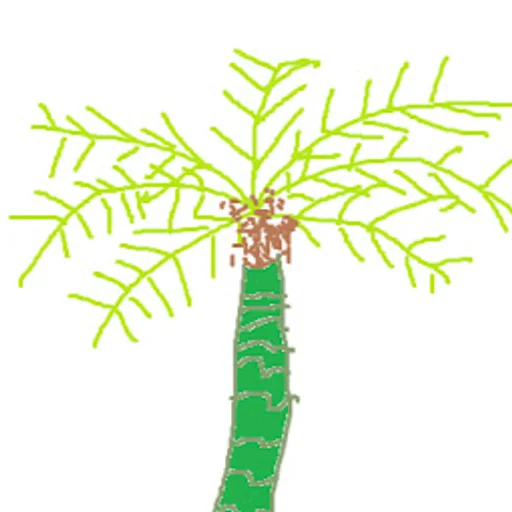
Ivan Shishkin, Rye (1878)

Problems/Arithmetic

Une formule simple pour le pgcd⁡(a,b)\operatorname{pgcd}(a,b)

by mathman·
30
Difficulty scaleÉchelle de difficulté

This score reflects both the level of the required concepts and the difficulty of the solution.Ce score tient compte à la fois du niveau des notions nécessaires et de la difficulté de la résolution.

  1. 1–10First steps / middle schoolPremiers pas / collège
  2. 11–25Beginner / high schoolDébutant / lycée
  3. 26–50Intermediate / undergraduateIntermédiaire / licence
  4. 51–70Advanced / graduateAvancé / master
  5. 71–90Expert / specializedExpert / spécialisé
  6. 91–100Research levelNiveau recherche
These levels are approximate guides.Ces niveaux sont des repères approximatifs.
·
ReviewedReviewed by Sequoia
·
Français

Showing the Français version because no English translation exists yet. Add that translation.

Démontrez que :
pgcd⁡(a,b)=2∑k=1a(12+⌊kba⌋−kba)=2∑k=1b(12+⌊kab⌋−kab).\displaystyle \operatorname{pgcd}(a,b)= 2\sum_{k=1}^{a}\left(\frac{1}{2}+\Big\lfloor k\frac{b}{a} \Big\rfloor- k\frac{b}{a}\right)= 2\sum_{k=1}^{b}\left(\frac{1}{2}+\Big\lfloor k\frac{a}{b} \Big\rfloor- k\frac{a}{b}\right).

I solved itMark it doneAdd to my listKeep it in your list

Hints

1

Hint 1

Open this only if you want a small nudge before looking at the solutions.

Solutions

1
Reveal solutionsAre you sure? Give it a try first.

Solution by mathman

Discussions0 useful votes

Appliquez le théorème de Pick à un triangle rectangle de cotés a et b

Report

For an unclear, ambiguous, or possibly incorrect statement, please use the Discussion tab on the right. Report content that needs moderator intervention, such as dangerous, clearly non-mathematical, or plagiarized content.