

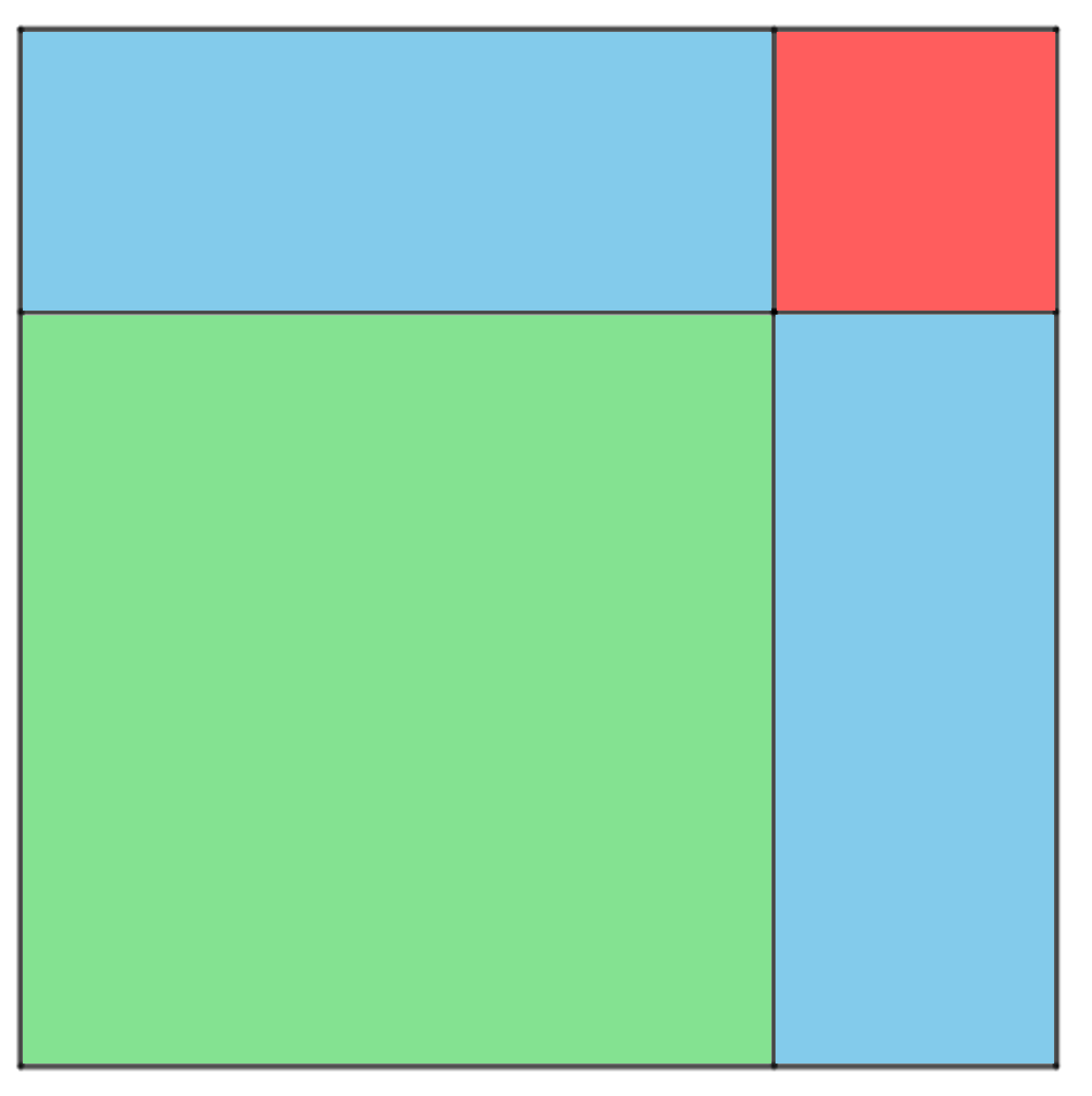
Let and be two strictly positive real numbers. Inspired by the figure below, determine geometrically, in terms of and , an expression for one root of the quadratic equation:
NB: this method was proposed in the 9th century by the Arabized mathematician Al-Khwârizmî.


References
- Histoire des sciences arabes — tome 2
Details
Chapitre 2 - L'algèbre
Export references
Hints
1Hint 1
Open this only if you want a small nudge before looking at the solutions.
Solutions
1Reveal solutionsAre you sure? Give it a try first.
Solution by Ancient Tree
Let be a positive real number such that .
We construct a figure as in the statement, such that the side length of the green square is , and the width of the blue rectangles is .
In doing so, the area of the green square plus the areas of the two blue rectangles is equal to , which is equal to by assumption.
By adding the small red square of side length , we obtain a large square of side length . Adding all the areas, its area is
Hence, taking square roots, the side length of the large square is:
Finally, we obtain:
Note that this is indeed the strictly positive root that one would obtain using the discriminant.
Verification
Starting again from the equation .
The discriminant is given by:
There are therefore two roots, given by:
This second root is exactly the found in the exercise; it is strictly positive since