


Ivan Shishkin, Rye (1878)

Problems/General algebraReviewed

Geometric determination of a solution to the equation x2+px=qx^{2}+px=q

by goldfinch·translated by Ancient Tree·
20
Difficulty scaleÉchelle de difficulté

This score reflects both the level of the required concepts and the difficulty of the solution.Ce score tient compte à la fois du niveau des notions nécessaires et de la difficulté de la résolution.

  1. 110First steps / middle schoolPremiers pas / collège
  2. 1125Beginner / high schoolDébutant / lycée
  3. 2650Intermediate / undergraduateIntermédiaire / licence
  4. 5170Advanced / graduateAvancé / master
  5. 7190Expert / specializedExpert / spécialisé
  6. 91100Research levelNiveau recherche
These levels are approximate guides.Ces niveaux sont des repères approximatifs.
·
English
EnglishFrançais

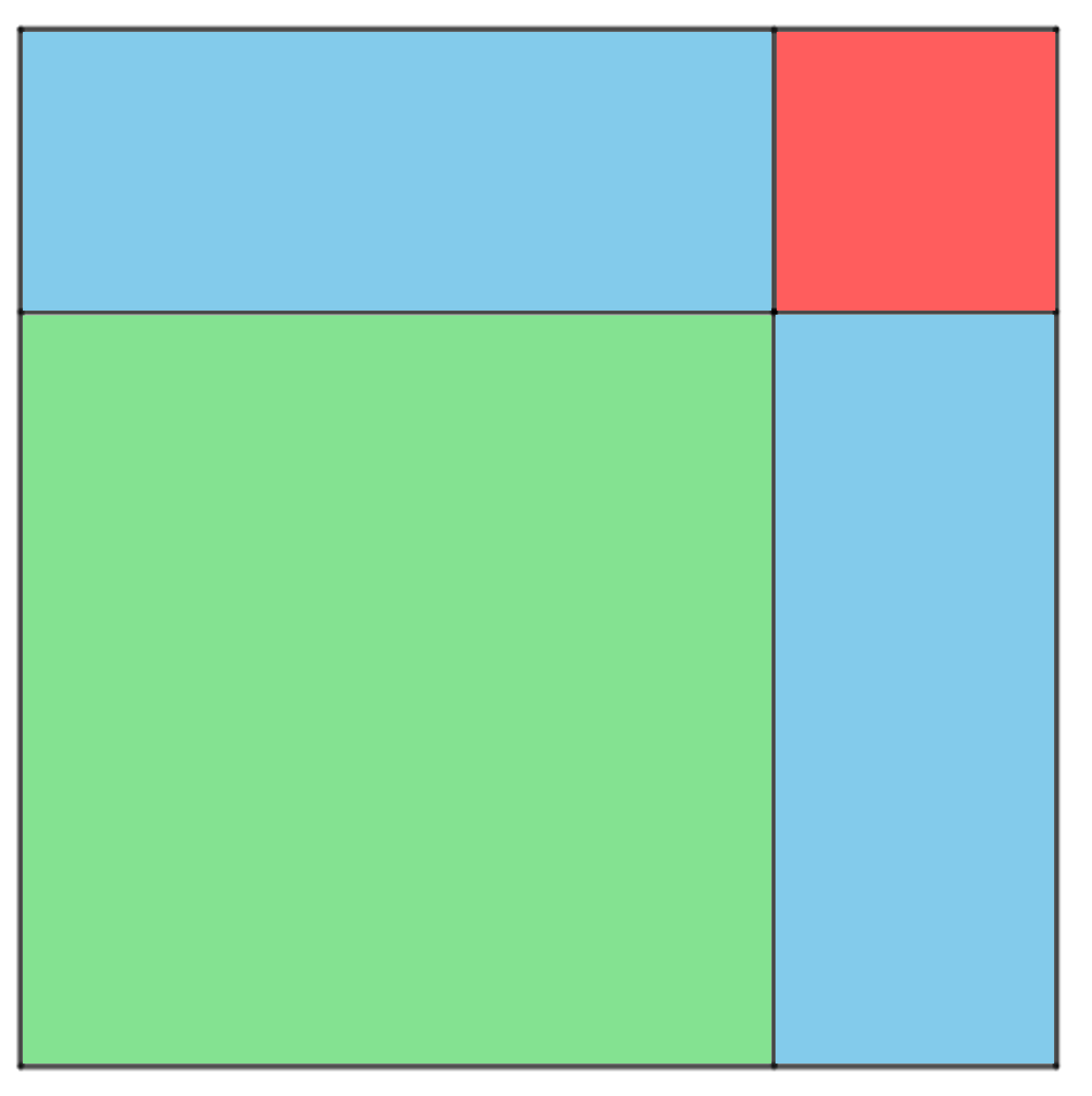
Let pp and qq be two strictly positive real numbers. Inspired by the figure below, determine geometrically, in terms of pp and qq, an expression for one root of the quadratic equation:
x2+px=q.x^{2}+px=q.

NB: this method was proposed in the 9th century by the Arabized mathematician Al-Khwârizmî.
alkh

I solved itMark it doneAdd to my listKeep it in your list

References

  1. Histoire des sciences arabes — tome 2
Details

Chapitre 2 - L'algèbre

Export references

Hints

1

Hint 1

Open this only if you want a small nudge before looking at the solutions.

Solutions

1
Reveal solutionsAre you sure? Give it a try first.

Solution by Ancient Tree

Discussions0 useful votes

Let xx be a positive real number such that x2+px=qx^{2}+px=q.
We construct a figure as in the statement, such that the side length of the green square is xx, and the width of the blue rectangles is p2\frac{p}{2}.

In doing so, the area of the green square plus the areas of the two blue rectangles is equal to x2+pxx^{2}+px, which is equal to qq by assumption.

By adding the small red square of side length p2\frac{p}{2}, we obtain a large square of side length x+p2x+\frac{p}{2}. Adding all the areas, its area is
x2+px+(p2)2=q+p24.x^{2}+px+\left(\frac{p}{2}\right)^{2}=q+\frac{p^{2}}{4}.

Hence, taking square roots, the side length of the large square is:
x+p2=q+p24.x+\frac{p}{2}=\sqrt{q+\frac{p^{2}}{4}}.Finally, we obtain:
x=q+p24p2.x=\sqrt{q+\frac{p^{2}}{4}}-\frac{p}{2}.

Note that this is indeed the strictly positive root that one would obtain using the discriminant.

Verification

Starting again from the equation x2+pxq=0x^{2}+px-q=0.
The discriminant is given by:
Δ=p24(q)=p2+4q>0.\Delta=p^2-4(-q)=p^2+4q>0.There are therefore two roots, given by:
x1=pp2+4q2=p2p24+q,x2=p2+p24+q.x_1=\frac{-p-\sqrt{p^2+4q}}{2}=-\frac{p}{2}-\sqrt{\frac{p^2}{4}+q}, \quad x_2=-\frac{p}{2}+\sqrt{\frac{p^2}{4}+q}.This second root x2x_2 is exactly the xx found in the exercise; it is strictly positive since
p24+q>p24=p2.\sqrt{\frac{p^2}{4}+q}>\sqrt{\frac{p^2}{4}}=\frac{p}{2}.

Report

For an unclear, ambiguous, or possibly incorrect statement, please use the Discussion tab on the right. Report content that needs moderator intervention, such as dangerous, clearly non-mathematical, or plagiarized content.