
Solution
Solution by goldfinch · translated by Ancient Tree · EN


(NB: the figure below clearly has a scale problem, but it allows us to carry out the reasoning.)
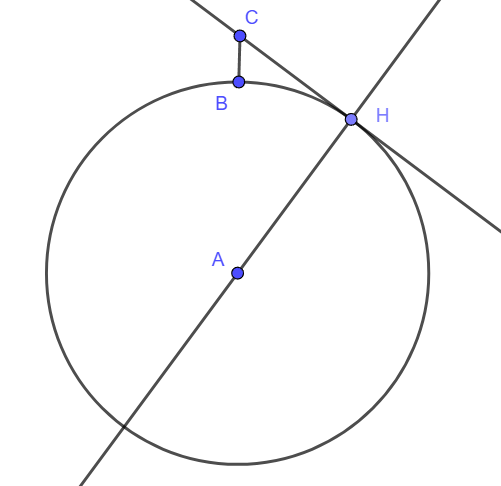
Let BC be the height of the person looking at the horizon (more precisely, BC is the height between their eyes and the surface of the water), CH their line of sight, and AH the radius of the Earth. The line of sight is tangent to the Earth at point H, the horizon point beyond which the surface of the Earth is no longer visible to the observer at C because of the curvature of the Earth beyond H. The distance we want to determine is HC.
The triangle AHC is right-angled at H, so by the Pythagorean theorem,
We can neglect compared with and obtain the following expression for HC:
Numerical application: the value of BC is not given in the problem statement, but we can easily estimate its order of magnitude.
For a person who is tall standing in of water, we have .
Then .
For a person who is tall standing in of water, we have .
Then .
No messages yet.