


Ivan Shishkin, Rye (1878)

Problems/Other

The horizon

by Mineral·translated by Ancient Tree·
20
Difficulty scaleÉchelle de difficulté

This score reflects both the level of the required concepts and the difficulty of the solution.Ce score tient compte à la fois du niveau des notions nécessaires et de la difficulté de la résolution.

  1. 110First steps / middle schoolPremiers pas / collège
  2. 1125Beginner / high schoolDébutant / lycée
  3. 2650Intermediate / undergraduateIntermédiaire / licence
  4. 5170Advanced / graduateAvancé / master
  5. 7190Expert / specializedExpert / spécialisé
  6. 91100Research levelNiveau recherche
These levels are approximate guides.Ces niveaux sont des repères approximatifs.
·
ReviewedReviewed by Ancient Tree
·
English
EnglishFrançais

You are standing on the beach, with your feet in the water, looking out at the ocean in the distance.

How far away from you is the horizon, that is, the farthest point your line of sight reaches on the surface of the water?

Given: radius of the Earth R=6371R = 6371~km.

I solved itMark it doneAdd to my listKeep it in your list

Hints

1

Hint 1

Open this only if you want a small nudge before looking at the solutions.

Solutions

1
Reveal solutionsAre you sure? Give it a try first.

Solution by goldfinch · translated by Ancient Tree

Discussions0 useful votes

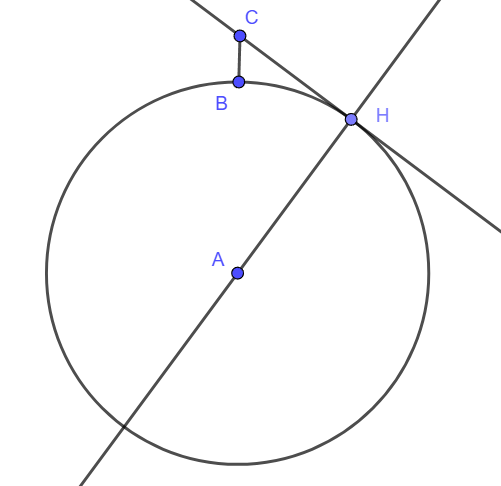
(NB: the figure below clearly has a scale problem, but it allows us to carry out the reasoning.)
image

Let BC be the height of the person looking at the horizon (more precisely, BC is the height between their eyes and the surface of the water), CH their line of sight, and AH the radius of the Earth. The line of sight is tangent to the Earth at point H, the horizon point beyond which the surface of the Earth is no longer visible to the observer at C because of the curvature of the Earth beyond H. The distance we want to determine is HC.

The triangle AHC is right-angled at H, so by the Pythagorean theorem,
AC2=AH2+HC2AC^2=AH^{2}+HC^{2}(R+BC)2=R2+HC2(R+BC)^2=R^{2}+HC^{2}R2+BC2+2×R×BC=R2+HC2R^{2}+BC^2+2\times R\times BC=R^{2}+HC^{2}

We can neglect BC2BC^2 compared with 2×R×BC2\times R\times BC and obtain the following expression for HC:
HC=2R×BCHC=\sqrt{2 R\times BC}

Numerical application: the value of BC is not given in the problem statement, but we can easily estimate its order of magnitude.

For a person who is 1m701m70 tall standing in 10cm10 cm of water, we have BC=1.60mBC=1.60 m.
Then HC=4.52kmHC = 4.52 km.

For a person who is 1m901m90 tall standing in 10cm10 cm of water, we have BC=1.80mBC=1.80 m.
Then HC=4.79kmHC = 4.79 km.

Report

For an unclear, ambiguous, or possibly incorrect statement, please use the Discussion tab on the right. Report content that needs moderator intervention, such as dangerous, clearly non-mathematical, or plagiarized content.