


An Egyptian papyrus, known as the Rhind papyrus, copied around 1650 BCE, contains a number of mathematical and computational problems useful in everyday life. Problem 48 gives a technique for computing the area of a disc of diameter in the following form:
"Take away one ninth from the diameter, then multiply the result by itself".
Written in modern form, the area of a disc of diameter would therefore be:
Let us reconstruct the presumed origins of this rule.
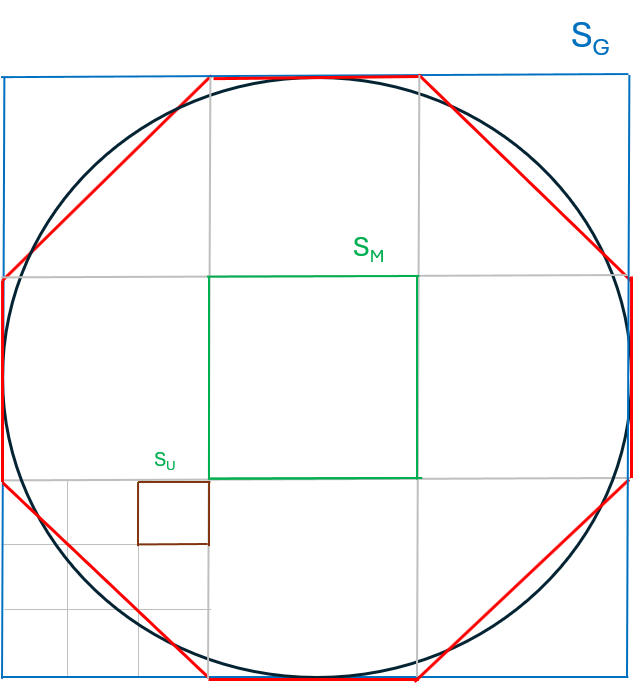
Consider an irregular octagon constructed, as in the figure below, inside a large square of area in which the circle under study is inscribed, this large square being made up of nine medium squares of area , each having an area of 9 unit areas .
Express, in the manner of the Egyptians, the area of the octagon in unit areas .
Noticing that the area of the octagon was very slightly less than that of the disc, the Egyptians then added one unit area to it in order to estimate the area of the disc. How many unit areas does this give?
Show that the technique proposed in the papyrus is consistent with this computation of the area via the octagon.
Given the modern formula for the area of a disc, compute an approximate value of from this Egyptian approach.
Solutions
2Reveal solutionsAre you sure? Give it a try first.
Solution by Ancient TreeFR
- La surface de l’octogone est composée d’un carré moyen central, 4 carrés moyens sur les côtés, plus 4 demi-carrés moyens, pour un total de 7 carrés moyens. Chaque carré moyen étant composé de 9 surfaces unitaires, on en déduit que l’aire de l’octogone est de unités.
- En ajoutant 1, on obtient unités de surface.
- Il faut se demander ce qu’est une unité de surface par rapport au diamètre du cercle : la relation clé est
D’où on obtient, d’après la question 2, que l’aire du disque est d’environ
qui est la formule annoncée. - L’aire d’un disque est donnée par où est le rayon du disque, soit ; d’où, sous l’approximation des Égyptiens :
En simplifiant par , puis en isolant , on trouve . Donc pas tout à fait la bonne valeur de , mais remarquable pour un document qui a été écrit plus d’un millénaire avant les Grecs anciens !
Solution by Ancient Tree
- The area of the octagon is made up of one central medium square, 4 medium squares on the sides, plus 4 half medium squares, for a total of 7 medium squares. Since each medium square is made up of 9 unit areas, we deduce that the area of the octagon is units.
- Adding 1, we obtain unit areas.
- We need to ask what a unit area is in terms of the diameter of the circle: the key relation is
From this we obtain, using question 2, that the area of the disc is approximately
which is the stated formula. - The area of a disc is given by , where is the radius of the disc, so ; hence, under the Egyptians' approximation:
Cancelling and then isolating , we find . So not quite the right value of , but remarkable for a document written more than a millennium before the ancient Greeks!