
Some friends are playing French Tarot with a 78-card deck.
The dealer deals the cards four at a time. However, when the last player realizes that he has two fewer cards than everyone else, he leaves the game.
The remaining players decide to divide all of his cards equally among themselves.
How many players are left?





References
- Math Woods
Details
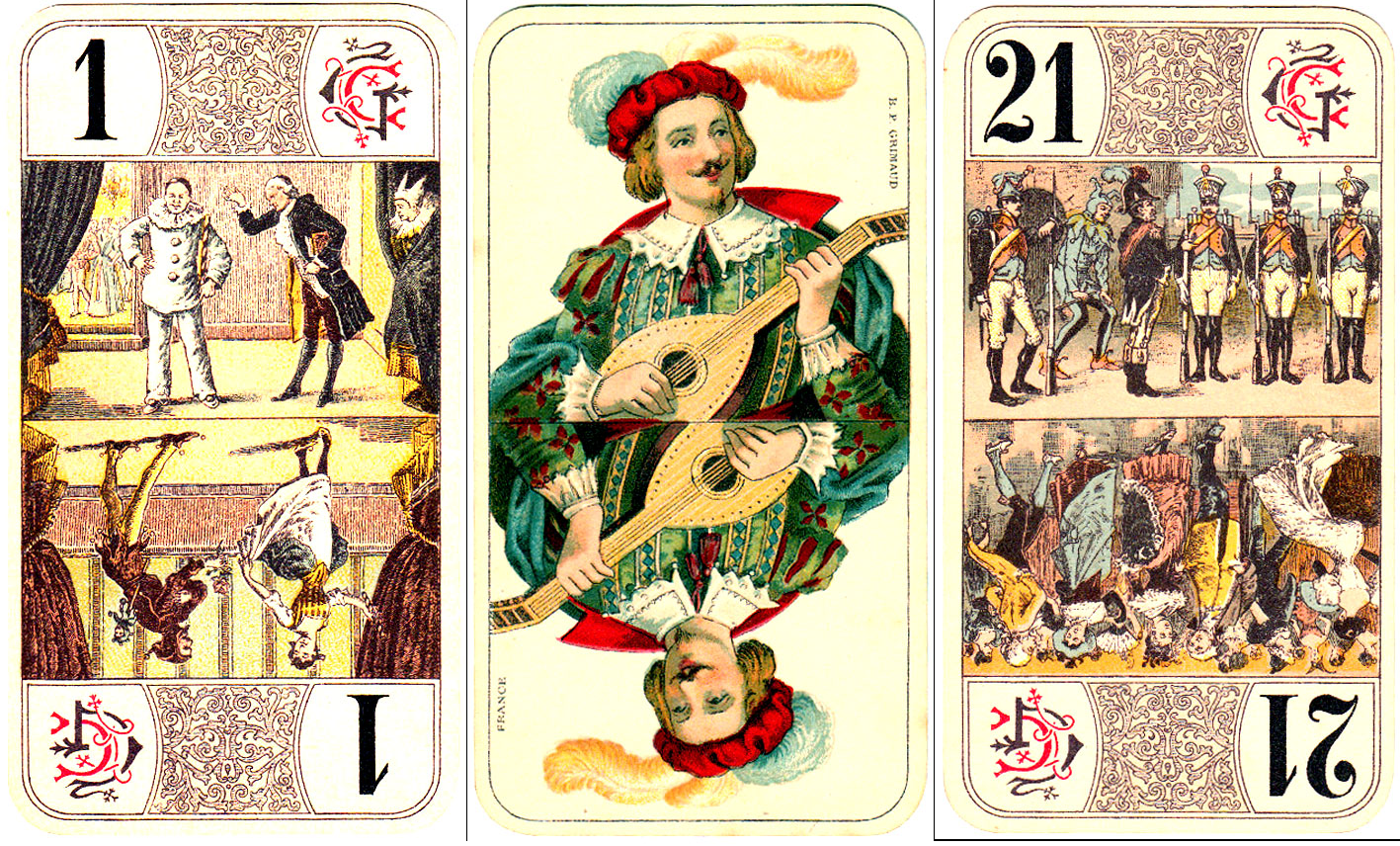
Image : Le 1 et le 21 d'atout, et l'excuse d'un jeu de tarot Grimaud de 1910 https://commons.wikimedia.org/wiki/File:Oudlers1910.PNG
Export references
Hints
1Hint 1
Open this only if you want a small nudge before looking at the solutions.
Solutions
1Reveal solutionsAre you sure? Give it a try first.
Solution by Ancient Tree
Let be the initial number of players, and the number of cards each player has, except for the last one, who has only .
We therefore have:
And hence .
Note that the cards were dealt four at a time, so the number of cards each player has (except for the last one...) is a multiple of 4:
(where, incidentally, is the number of rounds of dealing).
We therefore obtain
This leaves only the following possibilities:
- ,
- , (excluded, since there are several players)
- ,
- , (excluded, since the statement specifies that after the player leaves, several players remain).
- ,
- , .
There is one condition left to consider: since the remaining players divide all the cards of the player who left equally among themselves, this implies that
But checking the 4 remaining possibilities, only one of them is compatible with this condition.
Indeed:
- , is impossible, since does not divide .
- , is impossible, since does not divide .
- , is impossible, since does not divide .
- , is possible, since does indeed divide .
Therefore, there could only have been players initially; and hence only 3 players remain.