

Ivan Shishkin, Rye (1878)

Problems/TopologyReviewed

Compacity of the Julia sets

by Sequoia·translated by Ancient Tree·
50
Difficulty scaleÉchelle de difficulté

This score reflects both the level of the required concepts and the difficulty of the solution.Ce score tient compte à la fois du niveau des notions nécessaires et de la difficulté de la résolution.

  1. 110First steps / middle schoolPremiers pas / collège
  2. 1125Beginner / high schoolDébutant / lycée
  3. 2650Intermediate / undergraduateIntermédiaire / licence
  4. 5170Advanced / graduateAvancé / master
  5. 7190Expert / specializedExpert / spécialisé
  6. 91100Research levelNiveau recherche
These levels are approximate guides.Ces niveaux sont des repères approximatifs.
·
English
EnglishFrançais
This translation may be outdated. Its source text has changed since revision 1627.

Let PP be a polynomial of degree at least 22 and let zCz\in\mathbb{C}. We define the sequence (un(z))n(u_n(z))_n by u0(z):=zu_0(z):=z and un+1(z)=P(un(z))u_{n+1}(z)=P(u_n(z)).

We denote by KK the set of all zz such that the sequence (un(z))n(u_n(z))_n is bounded.

Show that KK is compact.

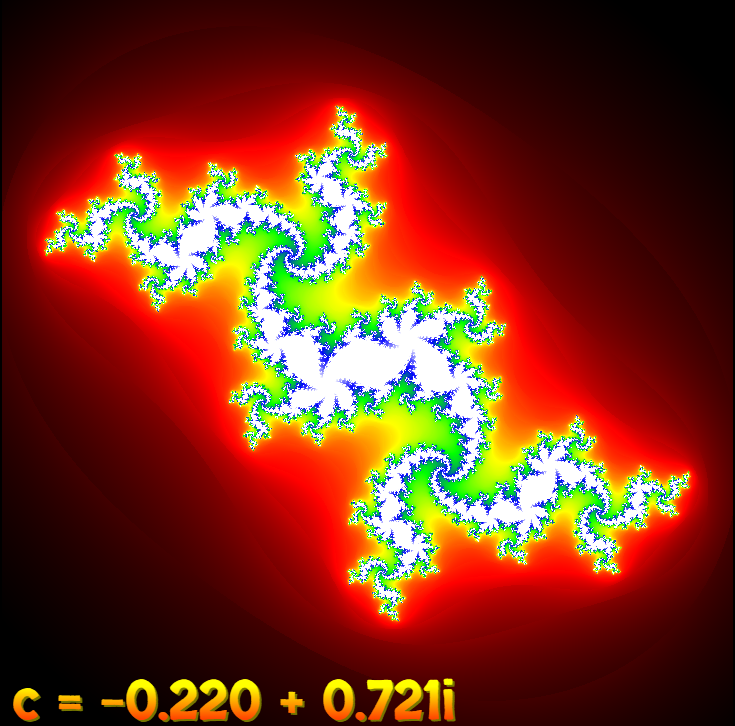
image

In the image below, such a set KK has been drawn for P(X)=X2+cP(X)=X^2+c. This is what is called a Julia set. It can be shown that a sequence (un(z))n(u_n(z))_n for this polynomial is necessarily bounded by 22 if it is bounded. To construct a Julia set and obtain this beautiful gradient, we look at the first index from which the sequence exceeds the critical value 22. The larger this index is, the closer the color associated with the parameter zz is to white, whereas if this index is small, the color tends toward black. The choice of the intermediate colors is purely aesthetic.

The well-known Mandelbrot sets, on the other hand, correspond to finding the values of cc for which our sequence is bounded, while fixing the initial condition u0u_0.

I solved itMark it doneAdd to my listKeep it in your list

Hints

1

Hint 1

Open this only if you want a small nudge before looking at the solutions.

Available in Français; this hint has not been translated into the current language yet.

Solutions

1
Reveal solutionsAre you sure? Give it a try first.

Solution by AndurilFR

Discussions0 useful votes

Notons que, par définition, un(z)=Pn(z)u_n(z)=P^{\circ n}(z)fn:=fff^{\circ n}:=f\circ \dots\circ f (composée nn fois).

Quand x\vert x\vert tend vers l’infini, x=o(P(x))\vert x\vert = o(P(x)) car PP est de degré au moins 22.
Ainsi il existe M>0M>0 tel que si x>M\vert x\vert>M, alors P(x)>2x\vert P(x)\vert>2\vert x\vert.
Donc si z>M|z|>M, en itérant cette inégalité, (Pn(z))nN(P^{\circ n}(z))_{n \in \mathbb{N}} n’est pas bornée (minorée en norme par 2nM2^{n}M).
D’où KB(0,M)K\subset \overline{B(0,M)} donc KK est bornée.

De plus, avec ce qui précède, KK est l’ensemble des zz tels que pour tout nNn\in\N, Pn(z)|P^{n}(z)| est inférieur à MM.
Ainsi K=nNun1(B(0,M))K=\bigcap_{n\in\N} u_n^{-1}(\overline{B(0,M)}) donc c’est une intersection de fermés (car les unu_n sont continues en tant que polynômes et la boule fermée de rayon MM est fermée). Donc KK est un fermé.

Ainsi, KK est fermé borné et on est en dimension finie donc c’est un compact.

Report

For an unclear, ambiguous, or possibly incorrect statement, please use the Discussion tab on the right. Report content that needs moderator intervention, such as dangerous, clearly non-mathematical, or plagiarized content.